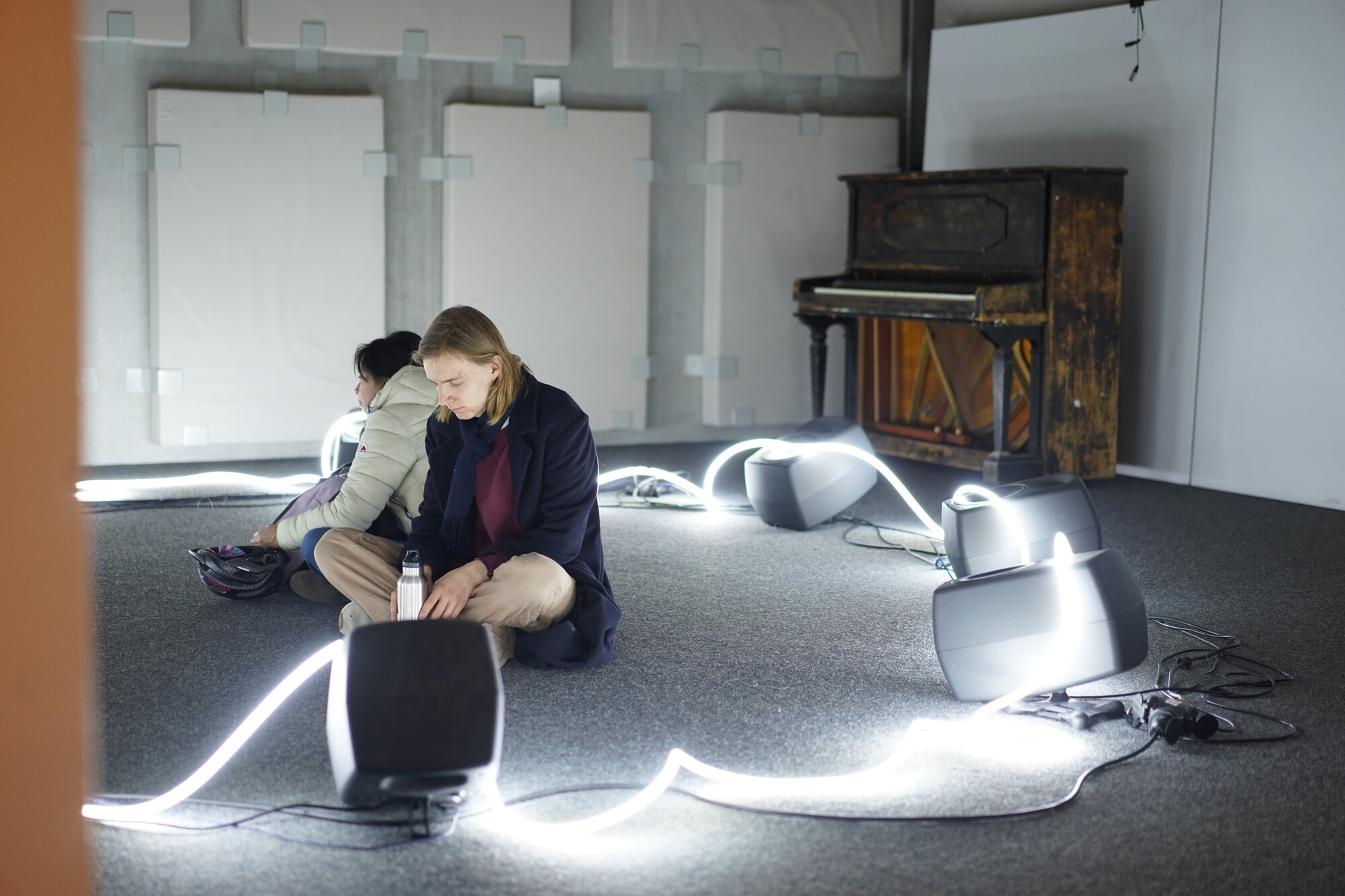
Bonsai Peng · KREIS, 2023 · Filmstudio der Hochschule für Musik Freiburg · Photography: Shiwei Liu
KREIS began after a breakup. Around that time, I came across Archimedes' final words: "Do not disturb my circle."
What moved me was not mathematics, but a kind of uncompromising idealism. Even in the face of death, one remains devoted to one's own circle. At that moment, it ceased to be merely a story about Archimedes and became a way for me to understand my own emotional state.
I responded by writing a long poem. Beginning with a triangle, then a square, a pentagon, a hexagon, and continuing toward an infinite-sided polygon, the poem gradually expanded until it ended with a single sentence: "No matter how many sides there are, don't touch my circle."
Later, I shared the poem with my composition professor. After reading it, he simply said: "This is music." That sentence changed the direction of the work. I began translating the poem into sound.
KREIS is an approximately forty-minute, eight-channel sound installation. The work is constructed entirely from a single sound source — the sound of a pencil drawing on paper. Taking the shortest sound perceptible to the human ear (3 milliseconds) as its fundamental temporal unit, the work treats each sound as an auditory pixel. Through stretching, compression, repetition, and spatial movement across eight loudspeakers, the piece attempts to prove the existence of a circle through sound.
Yet a true circle does not exist. A circle is a mathematical abstraction, approached through an infinite number of points. I know this proof is destined to fail, and that is precisely why I chose to undertake it.